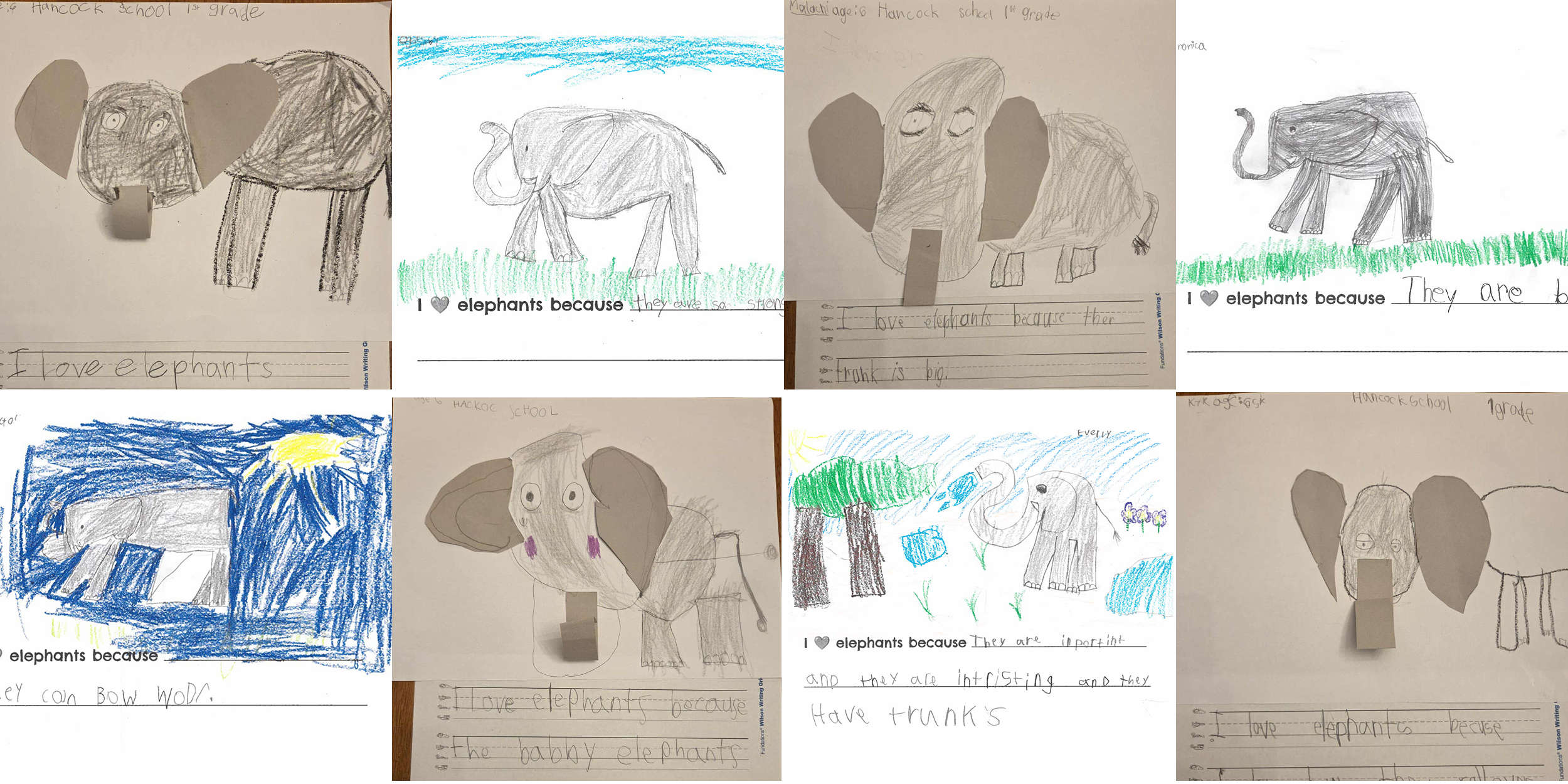
A collage of childrens' drawings of elephants

Through a Child’s Eyes: How Young Artists Are Championing Elephant Conservation

Celebrating Wildlife Conservation Day with Elementary School Creativity

When kids pick up crayons to draw elephants, something remarkable happens. Their artwork reveals not just colorful creatures with big ears and long trunks, but a profound connection between children and the natural world, a connection that holds the key to future wildlife conservation.

This Wildlife Conservation Day, we’re showcasing drawings created by 1st grade students who have learned about elephants and why protecting them matters. These young artists remind us that connecting kids to nature is about more than education, it’s about inspiring the next generation of conservation stewards.  We’d like to thank Ms. Taylor’s 1st grade class at Rosa Lee Carter Elementary in Ashburn, Virginia and Mrs. DiMaio’s 1st grade class at Hancock Elementary in Brockton, Massachusetts for their participation in Wildlife Conservation Day!

The Power of Connecting Children to Nature

Research shows that children who develop connections with wildlife early in life are more likely to become environmentally conscious adults (DeVille et al., 2021). When wildlife education programs introduce students to animals like elephants, they’re doing more than teaching facts about trunk length or habitat range. They’re fostering empathy, wonder, and a sense of responsibility for our planet’s incredible biodiversity.

The drawings featured in these galleries represent more than artistic talent. Each elephant represents a moment when a child looked beyond their everyday world and connected with a creature living thousands of miles away. That connection—between a second grader in a classroom and an elephant in the wild—is where conservation begins.

Why Elephants Matter: Lessons for Young Learners

Elephants are ecosystem engineers. These magnificent animals shape entire landscapes, creating waterholes used by countless species, dispersing seeds that grow into forests, and maintaining the delicate balance of their habitats. When children understand that protecting elephants means protecting entire ecosystems, they grasp a fundamental truth about conservation: everything is connected.

Elephants are remarkably intelligent and social animals. They live in family groups, communicate across long distances, care for their young for years, and even appear to mourn their dead. These characteristics resonate deeply with children, who see reflections of their own families and friendships in elephant herds.

Connecting Kids to Nature: A Conservation Strategy

Kids wildlife education programs like the one that inspired these drawings are essential conservation tools. When children learn about endangered species and threatened habitats, they don’t just acquire knowledge—they develop values that shape the choices they’ll make throughout their lives.

Connecting children to nature also creates ambassadors who spread conservation messages to their families and communities. Students go home and share what they learn. Dinner table conversations about wildlife protection, family discussions about reducing plastic waste, and children asking to donate their allowance to help wildlife become more commonplace. One drawing becomes a catalyst for broader engagement.

The benefits extend beyond conservation outcomes. Research suggests that children who spend time learning about and experiencing nature may show benefits including improved attention and reduced stress, with emerging evidence pointing to potential academic benefits as well (Mason et al., 2021; Nguyen & Walters, 2024; Vella-Brodrick & Gilowska, 2022). Nature connection supports whole-child development while simultaneously building a conservation ethic.

Looking Forward: Inspiring Tomorrow’s Conservationists

As we celebrate Wildlife Conservation Day, these drawings remind us why education and engagement matter. Today’s elementary school students are tomorrow’s researchers, policymakers, educators, and conservation leaders. The connections they form with wildlife now will influence their decisions for decades to come.

When you browse these galleries, you’re looking at more than children’s artwork. You’re seeing hope, connection, and the future of wildlife conservation rendered in crayon.

Hancock Elementary

Thank you to Mrs. DiMaio’s first grade class at Hancock Elementary in Brockton, Massachusettes for these outstanding Wildlife Conservation Day submissions!  

Rosa Lee Carter Elementary

Thank you to Ms. Taylor’s second grade class at Rosa Lee Carter Elementary in Ashburn, Virginia for these beautiful Wildlife Conservation Day submissions!  

References

DeVille, N. V., Tomasso, L. P., Stoddard, O. P., Wilt, G. E., Horton, T. H., Wolf, K. L., Brymer, E., Kahn, P. H., & James, P. (2021). Time spent in nature is associated with increased pro-environmental attitudes and behaviors. International Journal of Environmental Research and Public Health, 18(14), 7498. https://doi.org/10.3390/ijerph18147498 

Mason, L., Ronconi, A., Scrimin, S., & Pazzaglia, F. (2021). Short-term exposure to nature and benefits for students’ cognitive performance: A review. Educational Psychology Review, 34(2), 609–647. https://doi.org/10.1007/s10648-021-09631-8

Nguyen, L., & Walters, J. (2024). Benefits of nature exposure on cognitive functioning in children and adolescents: A systematic review and meta-analysis. Journal of Environmental Psychology, 96, 102336. https://doi.org/10.1016/j.jenvp.2024.102336

Vella-Brodrick, D. A., & Gilowska, K. (2022). Effects of nature (greenspace) on cognitive functioning in school children and adolescents: A systematic review. Educational Psychology Review, 34(3), 1217–1254. https://doi.org/10.1007/s10648-022-09658-5